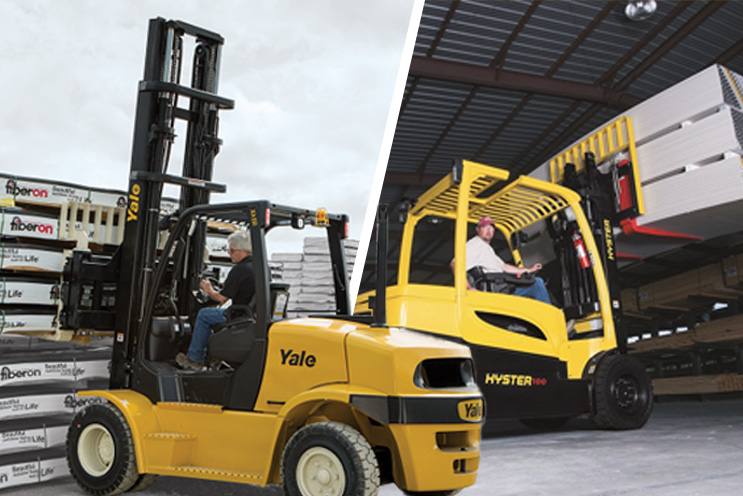
Forklifts come in many shapes and sizes, with different kinds of fuel and abilities to suit different situations. Finding the best forklift for your business will help you to increase efficiency and your bottom line while keeping your operators safe. Use these tips to help understand your options and then reach out to a member of our sales team for assistance.
Know Your Needs
Before looking at forklift options, you need to understand your goals. What will you be doing with a forklift? Here are some questions to ask about using a forklift for your specific application:
- How heavy are the items you need to move?
- Where are these items stored?
- What is the terrain and environment like?
- How much room do you have to maneuver equipment?
- Do you understand forklift safety concerns?
Every warehouse and application is different. If you’ve used equipment in this space before, you likely know the difficulties and challenges forklift operators will face in your specific environment. You also understand what capabilities your forklift needs to successfully support your team.
Choose the Right Type of Forklift
Some forklifts are a better fit than others for specific jobs and work environments. Here’s a quick summary of common forklift types so you can maximize efficiency and productivity while keeping your operators safe on the job.
Forklift Classes
When you purchase a forklift, it’s important to understand which class it belongs to. Classes I, II and III forklifts are all electric powered but operate differently and are used for different tasks. It is important to understand the differences. Here’s more about each class of forklift:
- Class I: These electric forklifts are considered counterbalance riders. The operator either sits or stands and the forklift has either three or four wheels. They are used indoors for loading and unloading trucks moving items within the warehouse.
- Class II: Class II forklifts are also electric and designed to work in warehouses. They have a tighter turner radius than Class I forklifts, allowing them to work in aisles and even reach into pallet racking. Reach trucks and order pickers are Class II forklifts. There is also a subset of Class II forklifts known as very narrow aisle forklifts, aka VNA, such as turret or articulated forklifts.
- Class III: These forklifts are often called pallet trucks or walkies. Operation varies: on some models the operator stands on the unit; on others, the operator walks behind the unit, or has the option to walk or ride. These are lower-capacity units used for loading, stacking and moving product. Walkie reach stackers and straddle stackers are Class III. So are traditional electric pallet jacks.
- Class IV: Class IV are internal combustion engine (aka ICE – often propane, but sometimes diesel) cushion tire forklifts typically used inside. Capacities range from a few thousand pounds to more than 15,000 pounds or even higher-capacity units used for rigging. With electric powered forklifts now offering equal capabilities to ICE trucks but with reduced maintenance costs, more and more Class IV users are switching over to Class I models. This move is also a result of consideration of the air quality inside their facility and over environmental concerns.
- Class V: Like Class IV forklifts, Class V trucks are powered by an internal combustion engine—propane or diesel and have pneumatic tires. They may be used both indoors or outdoors, but are typically operated outside. Capacities range to more than 100,000 pounds. Big and Jumbo forklifts are a subset of Class V. This class is also moving towards electrification.
These are the main five classes of forklifts, but there are others, including Class VII for rough terrain forklifts. Eastern Lift Truck Co. offers all classes of forklifts. Interested in learning more? Check out our Forklifts 101 Tutorial to Forklift Classifications.
The right class for you depends on how much power, maneuverability and space you’re working with. If your warehouse has narrow aisles and high vertical storage, Class II forklifts are a good choice. Each class of forklift is designed for the challenges operators will face, helping to improve efficiency while protecting worker health.
Common Forklift Types
Below are several forklift types commonly used in warehouses and distribution centers. These forklifts each have unique strengths and weaknesses, and the best one depends on your specific needs and the tasks you’ll use it for.
- Counterbalanced forklifts: Designed for moving materials in a warehouse, counterbalance forklifts have a weight at the back to balance loading and unloading in the front. Of course, it’s essential to only lift the amount of weight recommended by the manufacturer to avoid tipping.
- Reach trucks: These forklifts have an extended ability to lift, so they can reach and stack pallets in high racks. If your warehouse has high storage, reach trucks may be the best fit for your needs. Telehandlers are another type of forklift that works well for high lift heights.
- Pallet jacks: This style of forklift is specifically designed for moving and lifting pallets. It has a compact design that allows for high maneuverability even in tight spaces.
- Order pickers: If you need to move materials but don’t want to pick up an entire pallet, order pickers are the best fit for your needs. These forklifts have a platform that raises and lowers operators to the correct height for accessing materials.
- Side loaders: Wide or long loads may be easier to handle with a side loader, that picks up loads along the equipment’s side rather than in front. This type of forklift is a good choice if you’re storing timber, pipes or other oddly-shaped materials.
Choosing the right equipment based on design is important for running an efficient warehouse or distribution center. Of course, there are several specifics you’ll need to consider after choosing the type of forklift you’re interested in.
More Tips for Selecting the Right Lift Truck
Specifics like load capacity, lifting height and fuel type are all important factors in finding the right forklift. These details let you know what specific tasks a forklift can safely perform so you can assign operating tasks based on equipment capability. Here’s more about these specifications:
- Load capacity: The materials you’re moving determine the required load capacity for a forklift. If materials are too heavy or distribute weight unevenly, they can cause tip-over accidents. You should always use a forklift with a higher load capacity than the weight you’re actually moving for safety.
- Lifting height: Some forklifts can safely reach much higher than others. Depending on your pallet storage and load capacity, lifting height may be an essential factor for your best forklift.
- Fuel type: Electric forklifts use batteries, so they have zero emissions and low noise levels, making them a good fit for indoor work. Conversely, internal combustion forklifts run on gasoline, propane or diesel. They’re more powerful than electric models but create emissions and noise.
Other forklift factors to consider include ergonomics, types of tires and safety features. If operators will be using forklifts for a long time, equipment ergonimics can make a difference for efficiency and worker health. Different kinds of tires can handle surfaces for safer equipment use. Some forklifts also have more safety features than others.
Should You Buy or Rent a Lift Truck?
Your budget and business goals have the most impact on whether you rent a lift truck or buy one. If you need the equipment for the long term, purchasing it is usually the most cost-effective option. However, renting gives you access to high-quality equipment for a short time at a fraction of the purchase cost.
For more on this topic, reference this 2023 blog post.
How to Choose the Right Lift Truck for Your Business
You’ll have the best experience finding a new lift truck if you carefully vet the company you purchase or rent from. A full-service company can offer parts and maintenance to support your investment during equipment use. Companies that are authorized have been recognized by equipment brands and will have access to original equipment manufacturer (OEM) parts, service guarantees and other benefits.
Whether you choose to purchase new equipment or rent, the best forklift is the one that meets your needs and comes from a trustworthy company. Choosing the right lift truck for your business is a highly personal decision, but it’s one that a respected company can help you make with confidence.
Forklift Safety
A word about forklift safety… according to the United States Bureau of Labor Statistics (BLS), forklift accidents were responsible for 73 deaths in 2022. [The BLS reports on forklift accidents every other year.] Accidents can involve collisions, tipping over, mishandling loads and more. In addition to offering proper training for forklift operators, you can help prevent accidents by selecting the right forklift for your industry and application. Our point… treat your forklift with respect and have your operators trained.
If you’re interested in more information about forklift safety, the Material Handling Equipment Distributors Association (MHEDA) of which Eastern Lift Truck Co. is a long-time member, published this informative article in 2024.
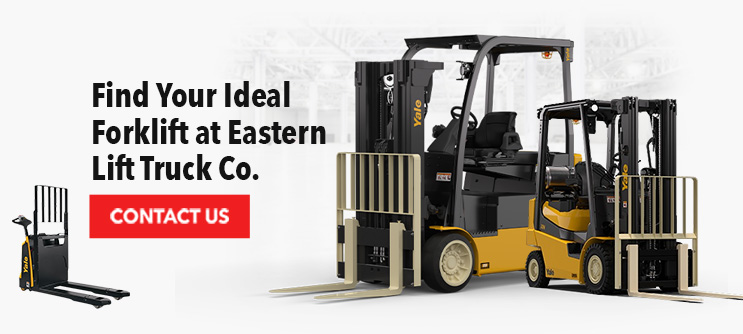
Find Your Ideal Forklift at Eastern Lift Truck Co.
Eastern Lift Truck Co. is a family-owned company, and we’re committed to cultivating loyalty, honesty and respect in all we do. Warehouse operators can find new and used material handling equipment, as well as a selection of rental options. In addition to forklifts, we offer everything you need to run a warehouse distribution center — from equipment to aftermarket care services and warehouse design.
We have an unparalleled reputation for quality service and are proud to offer operator and safety training programs in addition to our other services. Contact us today to find the right forklift for your application!