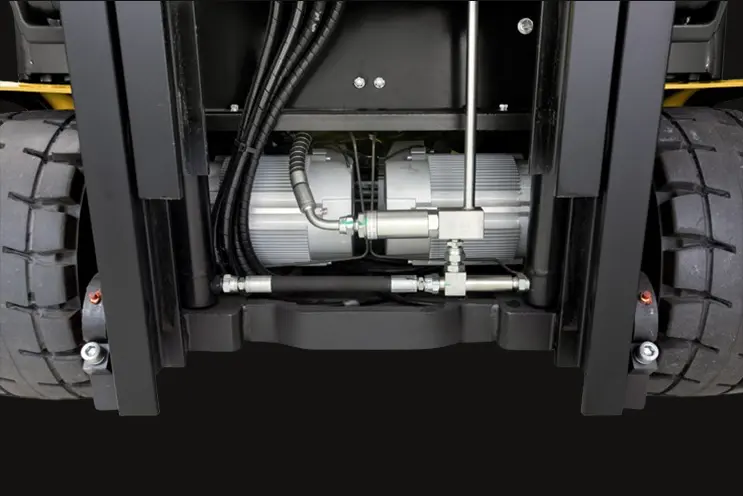
Forklifts are powered industrial trucks that specialize in moving, raising and lowering heavy loads. Also called “lift trucks,” they’re mainly designed to transport materials in industrial settings such as warehouses, dockyards and construction sites. Forklifts make moving operations faster and more efficient, meaning they’re significant equipment for manufacturing and distribution centers. Understanding how forklifts work can help you decide on the best equipment for your facility and needs.
How Does a Forklift Work?
Forklifts or lift trucks work by using two main mechanisms — a hydraulic system and a pulley system. These intersecting mechanisms work simultaneously to raise and lower loads. Hydraulic pistons are secured to the forklift’s vertical mast that holds the carriage assembly and the forks. Meanwhile, the chain system is secured to the forklift’s frame, with the pulley’s tensioning mechanism — often a fulcrum — positioned on top of the mast. The chain system is guided by sheaves, or wheels, as well as tensioning mechanisms.
A forklift works when hydraulic pressure is created, forcing the pistons to rise and move the mast upward. The hydraulics power the movement of the mast, which in turn moves the chains. With the same principle, releasing hydraulic pressure will move the mast downward, rotate the gears and lower the forklift’s load. The hydraulic and pulley systems are connected to forklift controls that enable the operator to move the load as needed.
Hydraulic and pulley systems are important mechanical applications that enable forklifts to move loads efficiently. These forklift technologies are further explained below:
Hydraulic System
When the operator pulls the lift handle, the pump sends fluid and creates pressure inside the hydraulic cylinders. Once the pressure is high enough, the pistons in the mast move higher. This decreases the pressure and creates a balanced state with equivalent weight from the forklift cargo and pressure from the hydraulic cylinders. As a result, the mast generates sufficient force to lift and carry the cargo. When the operator pushes or retracts the lift handle, it releases pressure, moves the pistons back and lowers the cargo.
A forklift hydraulic system includes a pump, cylinders, pistons, a control valve, a relief line, and a return line. Hydraulic fluids for forklifts include water-based fluids, petroleum-based fluids and synthetic fluids. Each type of fluid has different applications, and usage depends on the forklift’s operational requirements.
Roller Pulley System
The forklift’s roller pulleys are a crucial part of the guidance and mechanical advantage system. When the hydraulic pistons raise the mast, it pushes against the chains and causes the fulcrum gears to move clockwise. Without the chains pulling the mast upward, it cannot move higher than the length of the hydraulic cylinders. The chains enable the forklift to raise loads to a higher level.
The forklift’s pulley system consists of chains connected to the carriage and mast and a fulcrum gear on top of the mast. To lift higher loads, there are forklifts that have taller masts with four sets of rails and chains. Standard or simplex masts typically have a two-chain assembly.
Basic Components of a Forklift and Their Functions

Powered industrial lift trucks work because of different mechanisms that enable the movement and lifting of cargo. The truck frame or chassis serves as its base, where the forklift’s components are attached. The following are common components of forklifts and how they work:
- Power source: The two primary energy sources of forklifts are internal combustion engines and onboard electric batteries. Depending on the model, forklifts that run with traditional combustion can be fueled by gasoline, diesel, liquid petroleum gas or compressed natural gas. Meanwhile, electric forklifts powered by lead-acid batteries or lithium batteries are much quieter and do not emit carbon dioxide.
- Operator cab: The driver controls the forklift inside the operator cab (aka operator compartment, if not enclosed), which houses the forklift’s main controls, such as the steering wheel, accelerator and brake pedals, hydraulic controls, and directional lever. It also has an overhead guard that helps protect the operator.
- Counterweight: As the name implies, the counterweight is a cast-iron or steel weight that is essential to capacity rating of the forklift. In electric forklifts, the industrial battery is also a part of the counterweight. All powered industrial trucks have a nameplate specifying their load capacity. Operators must not exceed the load capacity to maintain safe cargo handling.
- Carriage: The forklift carriage assembly is nested within the mast and moves up or down with the load backrest, load forks and other attachments, such as sideshifters or fork positioners. There are five carriage classes based on a forklift’s size and lifting capacity.
- Mast: The mast is the tallest upright structure of the forklift and is another key component of how forklifts operate. It holds hydraulic mechanisms responsible for elevating, lowering and placing cargo. Mast specifications vary and typically depend on the forklift’s capacity and the operation’s lifting and stacking requirements. There are four main types of forklift masts, with three-stage masts being the most common.
- Lift and tilt controls: Located near the steering wheel or directly next to the operator’s seat, hydraulic control levers allow the operator to move the forks up to raise cargo or down to lower it to the ground. The tilt control moves the mast forward or backward when collecting or stacking loads. The sideshifter control facilitates slight lateral movement to the left or right to aid in pallet entry without having the reposition the forklift. Lift, tilt and sideshifter controls are critical for how forklifts handle loads precisely.
- Steering controls: A forklift has a steering wheel, forward and reverse levers, an accelerator and brake pedal, a parking brake, and a horn. Some forklifts have grab handle locate within the operator compartment to protect the operator’s hand when driving in reverse. This handles is also equipped with a horn button.
Forklift operation is crucial for different industries, which is why many drivers undergo operator training and certification to master forklift safety and driving skills. As of 2023, 286,230 industrial truck operators were employed in warehousing and storage in America. It’s a number that rises as more industries continue to transport goods and organize their inventories.
Contact Eastern Lift Truck Co. for New and Used Forklift Equipment
If you’re looking for reliable industrial-powered trucks, contact Eastern Lift Truck Co. We have a comprehensive inventory of heavy-duty material handling equipment and provide new equipment, including all types of forklifts and parts, from leading industry manufacturers. You can also choose from our used equipment inventory to find more lift truck options that suit your storage facility’s needs.
With over 50 years in the business and 18 locations throughout the Mid-Atlantic, Eastern Lift Truck Co. is a trusted full-service forklift dealership offering loading dock and door equipment, aerial lifts, balers, pallet racks, warehouse design and more. Our company also provides operator and safety training programs. We look forward to working with you and helping your business grow!